
OSSLT Opinion Essay: Examples, Format and What Scores Well
The OSSLT opinion essay looks harder than it is. It doesn't ask for brilliant writing. It asks for one clear opinion and the proof to back it up, and once your teen sees that, the task stops feeling like a trap.
The fall OSSLT runs from November 3 to 30, 2026, so grade 10 students across Ontario are deep in practice for this task. Passing the OSSLT is one of the requirements for the Ontario Secondary School Diploma, so this one essay carries real weight. I'm an OCT-certified English teacher, and I tutor students online for the literacy test. Below you'll find the format I teach, an original example essay, practice topics, and the mistakes that cost students the most marks.
What the OSSLT opinion essay asks
On the test, this task has a plain name: "a series of paragraphs expressing an opinion." Your teen gets a question about an everyday issue and has to answer it with a clear stance, backed by reasons and details.
There's no reading passage to analyze and no right answer. Markers aren't checking whether they agree with your teen. They're checking whether your teen can state an opinion, explain it, and organize it so a reader can follow every step.
Sample OSSLT opinion essay topics
These are practice topics I wrote in the style of the test. Any of them works for a timed practice run:
- Should high schools start classes later in the morning?
- Is it better to read a book before watching the movie?
- Should students have to take a physical education course every year of high school?
- Are group projects a good way to learn?
- Should cities offer free public transit for teenagers?
OSSLT opinion essay format (5 paragraphs)
The test asks for a series of paragraphs, not a set number. Still, five paragraphs give your teen a reliable shape that holds up under time pressure:
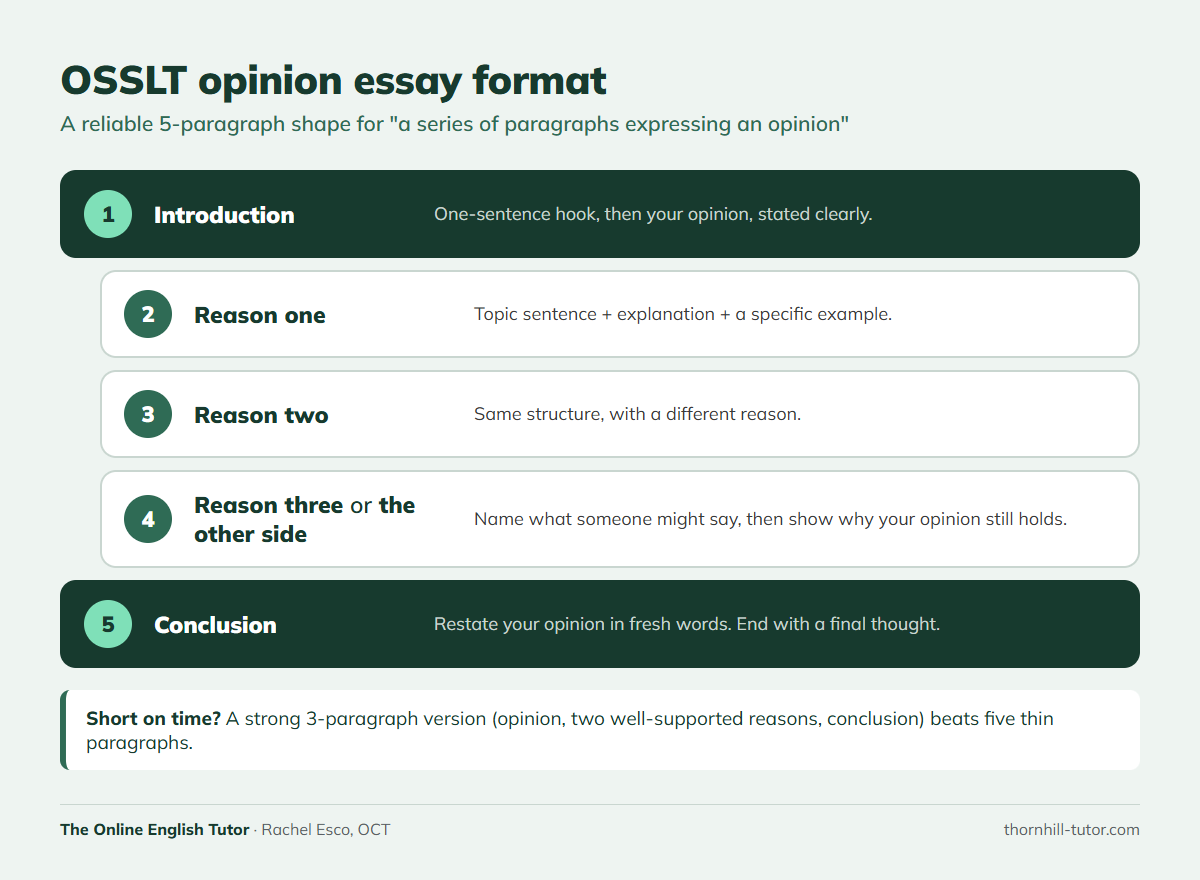
- Introduction. Hook the reader in one sentence, then state your opinion. Example: "High schools should start classes later in the morning."
- Reason one. Start with a topic sentence that names the reason. Add an explanation and a specific example.
- Reason two. Same structure, different reason.
- Reason three, or the other side. Give a third reason, or name what someone who disagrees might say and show why your opinion still holds.
- Conclusion. Restate your opinion in fresh words and end with a final thought.
Short on time? A strong three-paragraph version (opinion, two well-supported reasons, conclusion) beats five thin ones. It's the same structure university writing guides, such as Purdue's Online Writing Lab, teach for argument essays, so the skill keeps paying off long after grade 10.
OSSLT opinion essay example
Here's an original example I wrote for the topic "Should high schools start classes later in the morning?" Notice how every paragraph points back to the opinion.
Most teenagers know the feeling of sitting in a first-period class while their brain is still in bed. High schools should start classes later in the morning, because students would learn more and feel better.
First, students would learn more. A student who is half asleep can copy notes, but they can't really think about them. If classes started even an hour later, more students would be awake enough to ask questions and join discussions, which is where real learning happens.
Second, students would feel better. Many teens stay up late finishing homework after sports, jobs or family responsibilities. A later start would give them more sleep, and well-rested students are usually calmer and more patient with the people around them.
Some people argue that a later start would make it harder for students to get to jobs and activities after school. That's a fair concern, but schools could adjust bus times and activity schedules. Being alert for the whole school day matters more than finishing an hour earlier.
In the end, a later start is a simple change with real benefits. If schools want students to do their best, they should let them arrive awake.
It isn't fancy. It's clear. The opinion lands in the first paragraph, each body paragraph has one job, and the conclusion repeats the position without copying the opening word for word. The fourth paragraph also deals with the other side in a few sentences, which shows a writer who has thought it through without losing their footing.
What scores well
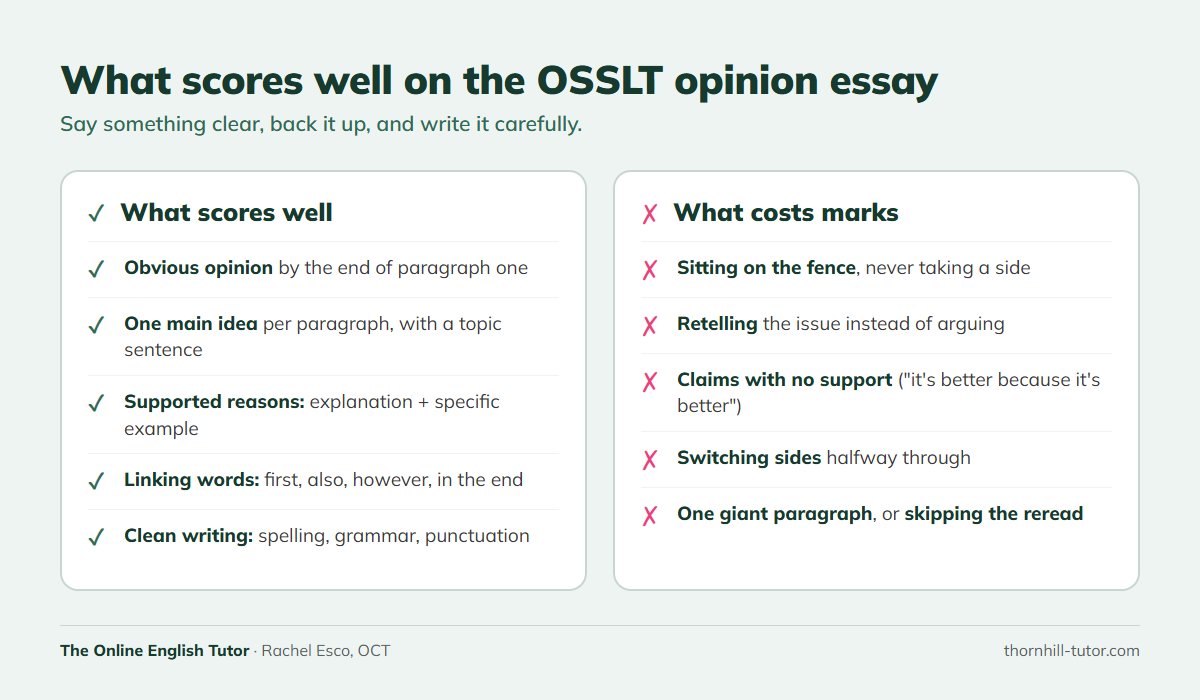
When I review OSSLT opinion essay examples with students, the strong ones share a few habits:
- The opinion is obvious. A reader knows the writer's position by the end of the first paragraph.
- Each paragraph has one main idea. It starts with a topic sentence and stays on that point.
- Reasons come with proof. Every reason has an explanation and a specific example, not a bare claim.
- It flows. Linking words such as "first," "also," "however" and "in the end" guide the reader.
- It's clean. Spelling, grammar and punctuation are careful enough that they don't get in the way.
What the OSSLT opinion essay rubric looks for
The scoring guides from EQAO, the agency that runs the OSSLT, have focused on two areas: how well the writer develops their opinion with supporting details, and how well they handle spelling, grammar and punctuation. In plain terms: say something clear, back it up, and write it with care. Your teen's teacher can share the scoring guides their school uses for practice.
Common mistakes
A grade 10 student I tutored in Thornhill kept losing marks on opinion practice, and his writing wasn't the problem. He was trying so hard to be fair to both sides that his answer never took a position. Once he picked one side and backed it with two solid reasons, his answers began to sound like an opinion.
That fence-sitting habit is the most common mistake by far. Here are the others I see most:
- Retelling instead of arguing. Describing the issue at length without saying what you think.
- Reasons with no support. "Later starts are better because they're better for students" is a claim, not a reason.
- Switching sides. Starting with one opinion and drifting toward the other by the end.
- One giant paragraph. Even good ideas lose marks when the reader can't see the structure.
- Skipping the reread. Two minutes of checking catches missing words and run-on sentences.
For practice under real test conditions, the official OSSLT practice booklets include opinion tasks, and my guide on how to prepare for the OSSLT covers the rest of the test.
How an OSSLT tutor can help
Most teens don't need fancier sentences to pass this task. They need to see the structure, practise it with feedback, and trust it on test day. That's where an OSSLT tutor helps: reading your teen's own practice essays, naming the one or two habits that cost marks, and fixing them before the test.
If your teen has written the test and is preparing for a retake, my post on what happens if you fail the OSSLT lays out a calm next-step plan. Not sure where your teen's writing stands? The Learning X-Ray assessment pinpoints it.
Lessons are one-on-one and online with a certified teacher. If you'd like help getting your teen ready, see how OSSLT tutoring works, and we'll start with the task that worries them most.

Leave a comment :)
Comments will be approved before showing up.
Also in School Scoop

What Happens If You Fail the OSSLT? A Calm Next-Step Plan
Failed the OSSLT? Nothing is taken away. Here's what happens next, the two routes to the literacy requirement, and a calm 6-step plan for the retake.

Signs Your Child Is Over-Relying on ChatGPT for Learning
Worried your child relies too much on ChatGPT? Key signs of AI overuse in learning, and how parents can guide smarter habits.

How ChatGPT in Education is Evolving
Discover how ChatGPT in education is changing learning—from personalized tutoring to smarter learning tools. Explore the impact of AI in classrooms and beyond.

Rachel Esco
Author